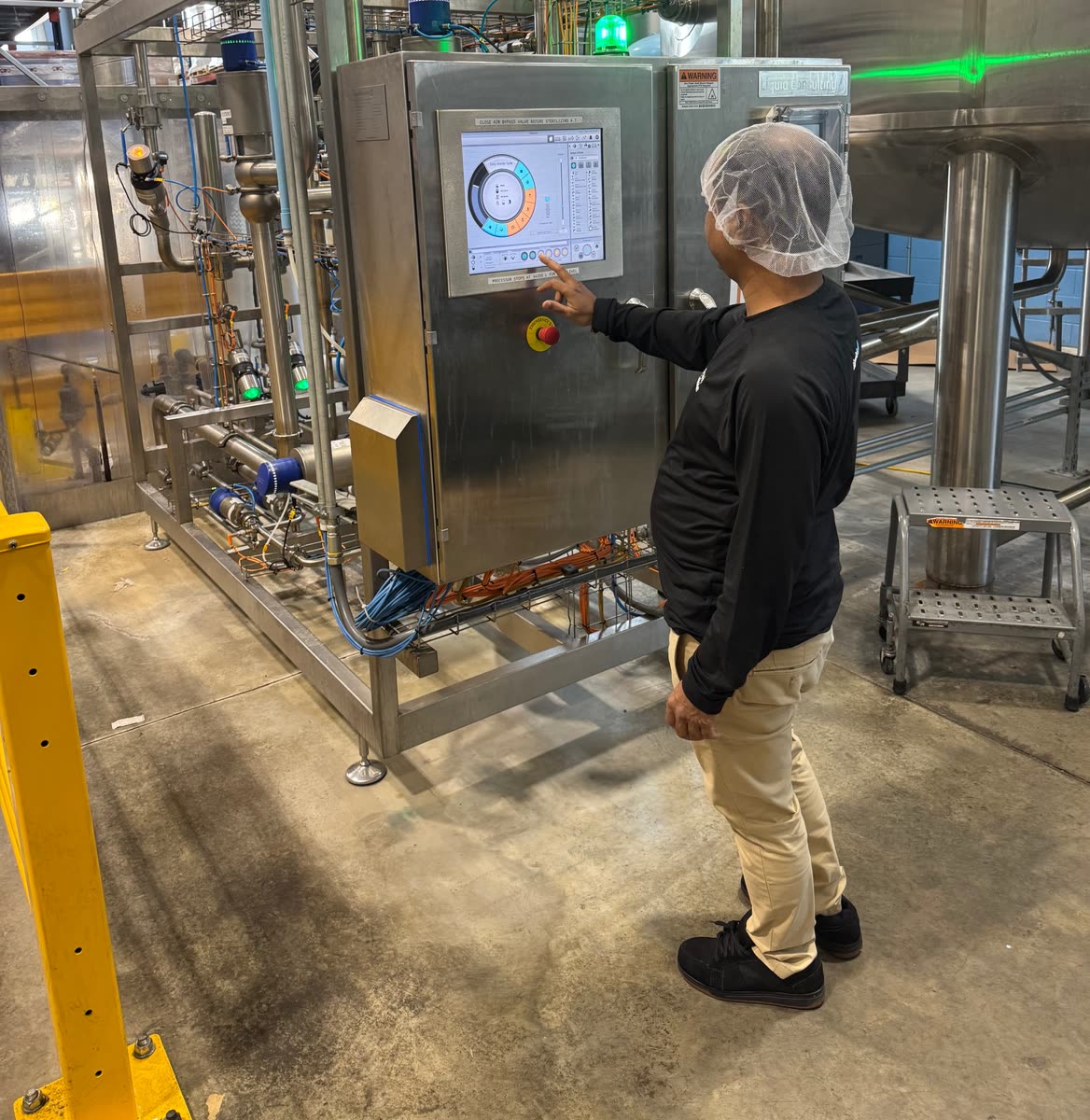
For a beverage or food manufacturer, the process line and the CIP system are the last places anyone wants surprises. Yet the controls behind them still need to change: legacy PLCs, end-of-life SCADA, a new CIP circuit, a recipe that has outgrown its logic. This guide is how Liquid, an automation consultant whose foundation is food and beverage, plans those changes so production keeps running: plan the work around production, stage changes into shutdown windows, and prove the new code off site before anything touches the live line.
1. Why controls changes cost production
A controls change on a running plant usually fails in one of three ways. The work starts before the plant has agreed when the equipment will actually be stopped. The new code meets the real line for the first time during the shutdown, so debugging the logic eats the window. Or the line is handed back before it is stable, and the problems show up on the next shift. On a process line or a CIP system, each of those means product, schedule and trust lost. Every hour of an unplanned stop costs all three.
2. Plan the work around production, not the other way round
Liquid works on running lines and plans the work around production. In practice that starts before anyone travels:
- The scope is agreed in writing, including what is out of scope, with a named site contact who signs off the work.
- The production plan is known: when the equipment will be stopped and available.
- The latest drawings, manuals and program backups the site holds are requested in advance — see the field service visit checklist for the full pre-site list.
- Engineering software matches the versions running on site, and a current backup of the PLC, HMI and drive programs is taken before any change.
- A change log is ready for every program or parameter change.
None of this is exotic. It is the difference between a shutdown window used for cutover and one used for discovery.
3. Stage changes into shutdown windows, with a fallback at each step
Changes are staged around planned shutdown windows. Critical systems are migrated in planned phases, with a fallback position at each step, so a step that does not go to plan can be backed out and the line returned to production. Equipment goes back to production only when it is stable and the site agrees.
4. Prove the new code off site before it touches the live line
Factory Acceptance Testing (FAT) runs off site, before anything touches your live system. New PLC, HMI and SCADA code is proven before the shutdown window, so the live cutover is shorter and lower risk. This is the step that protects production most: FAT takes out logic risk before the line stops, so the shutdown window is left for field risk, such as field I/O, instruments, valve timing and real hydraulics, which can only be proven on site.
5. Cutover on site: SAT and commissioning
Site Acceptance Testing (SAT) and commissioning happen at the plant, staged around shutdown windows and production constraints. Unless the project sets its own test sequence, Liquid's general commissioning sequence is:
- Before any water: check out I/O and instrument loops and verify safety functions and interlocks dry.
- Water test: prove flows, levels, interlocks and basic sequences on water before product.
- CIP test: prove cleaning sequences and local adaptations, recording concentrations, temperatures, times, flow or velocity and deviations, using the project's approved chemicals and methods. Confirm that the cleaning worked, for example by rinse conductivity, ATP swabs or visual inspection.
- Sterilization (aseptic systems): prove the SIP or sterilization sequence before any product.
- Product test: run with production product.
- Performance test: against criteria the project defined before the test. For an output guarantee on a new filling or packaging line, see the line performance test checklist.
Results, issues and fixes go into the field work report while the team is still on site.
6. Hand back only when production is stable
Remove forces, bypasses, temporary PLC and HMI settings and trace tags before the stability run, so the code proven stable is the code the plant keeps. Handover then needs three things: production is stable, the team is trained, and documentation is complete, including drawings, final backups that match the proven state, the change log and test evidence. Operator training is part of commissioning and handover.
Agree the quality and regulatory gates with the plant before the shutdown: QA hold and release of the first product after the change, and a review of the HACCP or food safety plan. In dairy, a change that touches pasteurizer timing or flow diversion logic falls under Grade A PMO public health controls and needs the regulatory authority involved. On aseptic or low-acid processes, a change that affects the filed process needs process authority review (21 CFR 113).
7. What this looked like on recent CIP work
Liquid's recent project work page summarizes anonymized jobs; customer and plant names are withheld. Three of them involve CIP systems:
- Batching and CIP upgrades, food and beverage plant (Midwest). Liquid updated the batching and CIP PLC programs and HMI screens, added a one-command CIP start for an aseptic tank, corrected blend-tank sequence logic, fixed an HMI-to-PLC alarm-acknowledgement fault and repaired CIP reporting in the HMI and SQL reports. Work was staged around production. The updated CIP sequences were commissioned and run on the plant's CIP circuits.
- Integrating a process unit with a plant CIP platform, dairy plant (Mid-Atlantic). Liquid designed and tested new CIP sequence logic, staged the work around production, and coordinated a changeover method between the existing and new CIP systems. The new sequence logic was tested on site.
- Chemical-dosing upgrade and Ignition SCADA, dairy plant (Western United States). Liquid updated the PLC, HMI and Ignition SCADA screens for new dosing equipment on an aseptic processing line. After dosing tests, the line completed CIP and sterilization and returned to production.
8. Before you plan your next change: start with an assessment
If you are not sure what to change first, or in what order, start with an Automation Assessment and Roadmap: a short site review of your PLC, HMI and SCADA systems with a system inventory, current-state map, risk register, prioritized backlog, architecture sketch and a concrete execution plan. It is the plan the shutdown windows are built from. Discovery starts with a 30-minute call. See the Automation Assessment and Roadmap.
Liquid works on Rockwell (Allen-Bradley), Siemens, Ignition, Wonderware (AVEVA), Schneider Electric and ABB, and matches the engineer to the platform your plant already runs. Food and beverage, breweries included, is the foundation, not the limit: Liquid also works in pharmaceutical, water and wastewater, mining and machine-builder operations.
Related Liquid resources
- Food and beverage automation
- Commissioning, FAT and SAT
- PLC programming and controls upgrades
- SCADA and HMI integration
- Recent project work
- Field service visit checklist
- Commissioning kickoff and close pack
- Line performance test
Questions: automation@liquidconsulting.com